
May 12, 2026 ● Careers in Defense
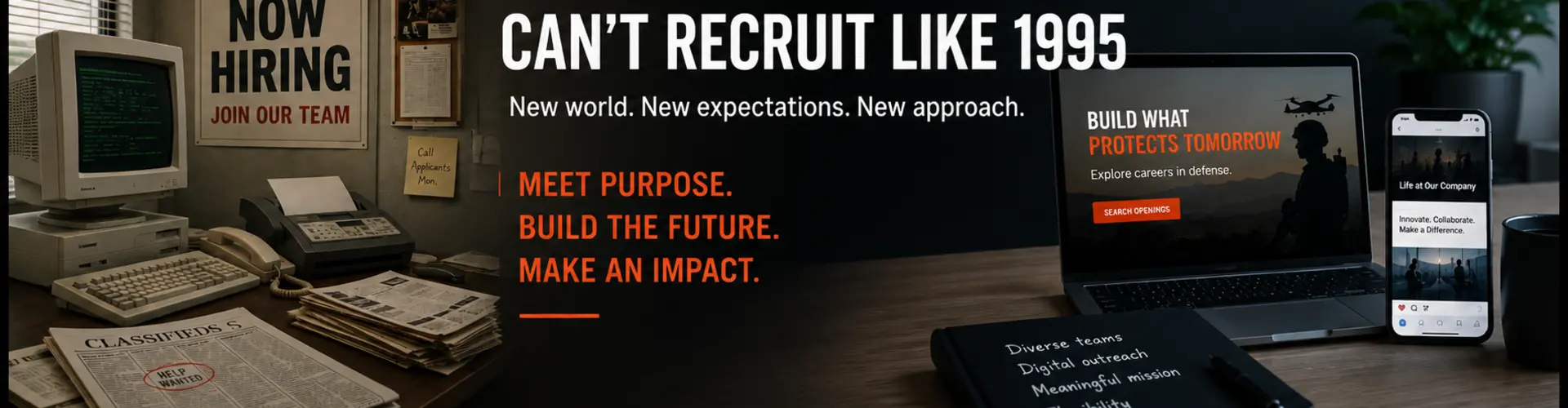
New World: Why Europe’s Defense Industry Can’t Recruit Like It’s Still 1995
The sector is spending billions on new capabilities. It’s spending almost nothing on figuring out how to hire the people who’ll build them. That needs to change.
Here’s a thought experiment: imagine a €50 billion European defense company tried to hire a senior software engineer today using the same process it used in 1995.
It would post a jargon-heavy job description on a government portal. It would require 10+ years of experience with specific military systems. It would offer no salary range. The application would involve uploading a PDF to a portal that looks like it was built in 2004. The candidate would hear nothing for three months. Then they’d get an email asking them to attend an in-person assessment centre in a city 500 kilometres away.
That engineer accepted a job at a Munich startup six weeks ago. She’s already shipping code.
This isn’t a caricature. It’s Tuesday.
The talent war defense is losing
The European defense sector needs to hire at a scale and speed it’s never attempted before. Rising budgets, new programs, and an accelerating technology cycle mean tens of thousands of roles need filling, many of them in software, AI, data, and cyber, where competition for talent is fiercest.
And the sector is losing. Not because the work isn’t compelling. Not because the compensation is terrible (it’s improved). Not because people don’t want to work in defense (many do). It’s losing because the way defense companies recruit is fundamentally broken.
Where it goes wrong
Job descriptions nobody understands
Defense job postings are notorious for being impenetrable. They’re loaded with acronyms (C4ISR, SIGINT, STANAG, ITAR), demand hyper-specific experience (“5 years with MIL-STD-1553 data buses”), and read like procurement documents rather than invitations.
For anyone outside the defense bubble, which is exactly the talent pool the industry needs to tap, these postings are a wall. They don’t communicate what the work is, why it matters, or what a great candidate looks like. They communicate: “if you don’t already know what this means, don’t bother.”
No employer brand
Ask a software engineer what it’s like to work at Google, Spotify, or even a Series A startup they’ve never heard of, they’ll have a sense. Ask what it’s like to work at most European defense companies? Blank stare.
Defense companies invest almost nothing in employer branding. Their careers pages are afterthoughts. Their social media presence is corporate boilerplate. They don’t publish engineering blogs, they don’t sponsor tech meetups, they don’t tell the stories of the people who work there.
In a market where candidates choose employers as much as employers choose candidates, being invisible is fatal.
Glacial hiring processes
The average time-to-hire in European defense is 3–6 months. In tech, it’s 2–6 weeks. That gap is where companies lose candidates.
The process typically involves multiple rounds of interviews spread over weeks, assessment centres, committee approvals, and security pre-checks, before a clearance process that adds more months. Each delay is an opportunity for the candidate to accept another offer.
The defence companies that complain loudest about talent shortages are often the ones with the slowest hiring processes. The irony is staggering.
Geographic rigidity
Many defense roles still require full-time on-site presence at specific facilities. For classified work, this is unavoidable. For the large portion of defense work that isn’t classified, it’s a choice, and an increasingly costly one.
Top talent, especially in software, has gotten used to remote and hybrid work. Telling a senior ML engineer they need to relocate to a specific town for a non-classified role isn’t a security requirement. It’s a recruitment handicap.
Compensation opacity
Defense companies are among the last industries to resist publishing salary ranges. In a market where transparency is becoming the norm, and in some countries, the law, this is actively harmful.
Candidates who don’t see a salary range assume the worst. And they’re often right. While defense compensation has improved, the refusal to be transparent about it costs companies candidates who would have been interested if they’d known.
What good looks like
Some organisations are getting it right. Here’s what they’re doing differently:
Writing human job descriptions. Clear language, focused on what the person will do and why it matters. Minimum requirements, not wish lists. “You’ll build the ML pipeline that helps analysts process satellite imagery 10x faster” beats “Experience with GEOINT exploitation frameworks required.”
Investing in employer brand. Engineering blogs. Employee stories. Open-source contributions. Conference talks. Showing, not telling, what the work looks like.
Moving fast. Compressing hiring to weeks, not months. Making conditional offers pending clearance. Giving hiring managers authority to decide without committee approval chains.
Offering flexibility. Hybrid by default for non-classified roles. Relocation support for roles that need it. Part-time options for senior specialists.
Being transparent. Publishing salary ranges. Being upfront about clearance requirements and timelines. Treating candidates like adults.
Going to where talent is. Tech conferences, university partnerships, online communities, specialised platforms. Not waiting for candidates to stumble onto a government portal.
The cost of doing nothing
Every role that takes six months to fill is six months of capability not delivered. Every qualified candidate who bounces off a bad careers page is a competitor’s new hire. Every engineer who never considers defense because they’ve never heard of your company is a permanent gap in your pipeline.
The European defense sector is in a generational hiring moment. The money is there. The political will is there. The technology roadmaps are ambitious and funded. The only bottleneck is people.
And people have options.
The companies that modernise how they recruit will build the capabilities Europe needs. The ones that don’t will wonder why they can’t hire, while sitting on the most compelling mission in the industrial world.
It’s 2026. Stop recruiting like it’s 1995.
Careers in Defense is the job platform built for how defense hiring should work — not how it’s always been done. [Explore roles →]